HUNGER REPORT 2025

Hunger is hurting people and families, our communities, and Ontario.

Hunger hurts people

The ongoing affordability crisis is pushing more Ontarians into poverty. Families who were once “just getting by” are now “barely holding on,” leading to more Ontarians than ever before with no choice but to turn to a food bank for help.
Each of the numbers that follow represents a person who is facing incredibly difficult choices just to get by. Parents who skip meals so their kids can eat, seniors choosing between groceries and medication, or workers doing everything they can to make ends meet but still falling short.
The persistent problem of food bank use in Ontario
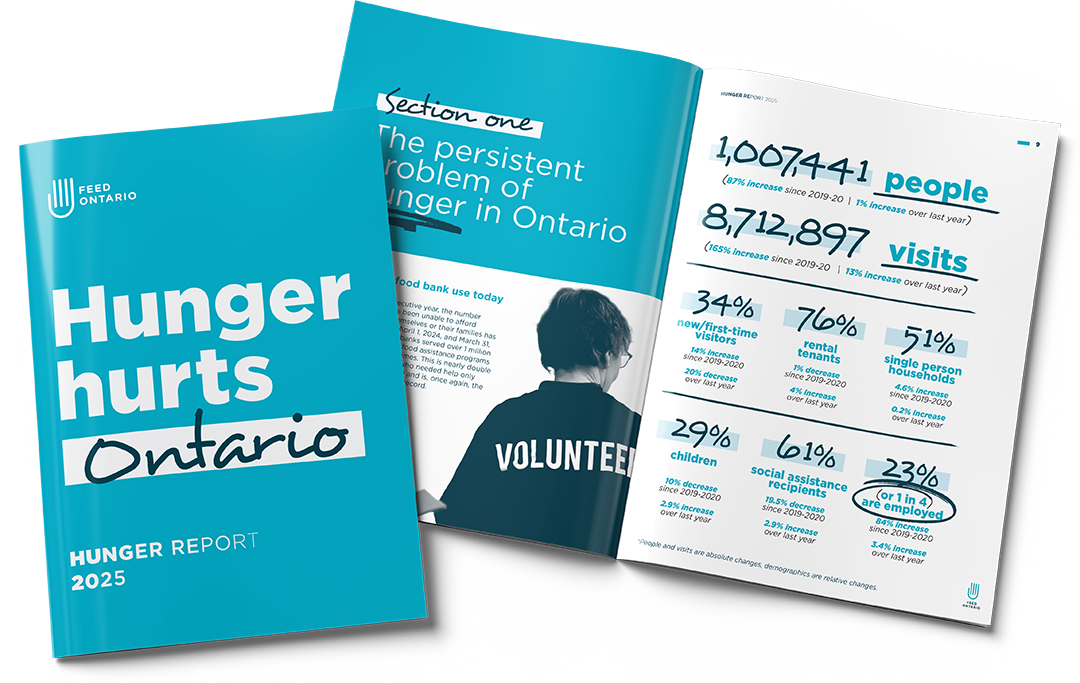
people used a food bank in Ontario between April 1, 2024 and March 31, 2025, nearly 10,000 more people than last year and a 87% increase since 2019-2020
visitors had a job, an 83% increase
over 2019-2020.
visits were made last year, a 13% increase over last year and a 165% increase since 2019-2020
Hunger hurts communities
Hunger isn't just a crisis for people and families - it's a crisis for Ontario. Spikes in food bank use are often a warning sign that some of our province's biggest challenges, like homelessness, an overcrowded healthcare system, and instability in our communities, could get even worse.
Though food banks are working hard to meet the rising need in their communities, they're reaching a breaking point. Keep reading to find out why persistently high food bank use is everyone's concern.
When food bank visits go up, homelessness follows
Spikes in food bank use often come before spikes in homelessness.
Often, homelessness does not happen quickly. For many people and families, it follows a progressive loss of choices as the gap between income and expenses widens. Before turning to a food bank, someone may first downsize their home, take out a loan, or ask friends and family for help. But, if their cost of living continues to rise and help is not enough, families eventually face eviction and even homelessness.
With over 1 million food bank visitors in Ontario at their last resort, this could be a sign that a rise in homelessness may be on the horizon.
When food bank visits go up, healthcare costs increase
Hunger hurts our healthcare system.
When people can’t afford their basic necessities, they are more likely to become sick. At the same time, Ontario’s hospitals are overcrowded, patients are facing record-long wait times, and health care resources are being stretched thin. This has made it harder for everyone to get the care they need.
More people than ever before are struggling to afford their basic necessities in the province, which may be a sign the healthcare system could become even more strained in the future.
When food bank visits go up, communities feel the pressure
Poverty erodes the trust people have in supportive systems and institutions.
It can be easy to lose hope that your financial circumstances will improve when, no matter how hard you try, you can’t afford your basic necessities. This can lead to places where people feel disconnected from each other, a sense of shared responsibility begins to break down, and where it becomes harder to build and sustain the kind of safe and stable neighbourhoods where everyone can thrive.
As a greater number of people face difficulty just getting by, our communities could begin to weaken even further.
Hunger hurts Ontario
Food banks are playing an essential role in communities and in Ontario. Without their service, more children, adults and seniors would go hungry, more families would lose their homes, and more people would not be able to access the healthcare they need.
Food banks are actively preventing some of the Province’s biggest challenges from getting worse, including homelessness, strain on the healthcare system, and instability in our communities.
But as hard and tirelessly as they work, food banks have been stretched to the breaking point. The need for help exceeds the resources that food banks have available to them and, if this need continues to rise, the consequences for the province will be significant.
Luckily, there is hope. The Government of Ontario is in the process of developing a new Poverty Reduction Strategy that could lay the foundation for a more coordinated approach, across all levels of government, for addressing these issues. This could mean solutions that prevent and end homelessness, improve the health and wellbeing of people and families, and build stronger communities across Ontario.
Feed Ontario believes that ending hunger is possible. Putting the following recommendations into action today can help to reduce the need for food banks in Ontario tomorrow.
Hunger hurts. You can help.
Support those accessing food banks today
You can help make sure food bank shelves across Ontario stay stocked for those hurt most by hunger.
For every $1 donated, we can provide 2 meals to someone in need.
Sign our petition
When our neighbours can’t afford enough to eat, it’s not just a crisis for their household – it’s a crisis for our communities and our province.
Sign our petition to tell the provincial government: it’s time to take real action to reduce hunger and poverty so all our communities can thrive.
Spend a month in someone else's shoes
Food bank visitors struggling to make ends meet often have to make difficult choices each day just to get by.
Try Fork in The Road to see if you could make it through the month on a tight budget.