It’s clear that hunger hurts the people and families experiencing it most, but the wider ripple affects of poverty can be harder to see. As more people than ever need to turn to a food bank to get by, communities across Ontario are weakened. Digging deeper shows how the high levels of food bank use in Ontario impact us all – in ways you might not expect.
Hunger impacts every region of the province, and it creates challenges in building the inclusive neighbourhoods we all want to call home.
Poverty erodes our connection with each other
When people struggle to make ends meet, their focus can turn to just getting by. Simply making it through the month and taking care of themselves and their family can become more important than sustaining their connections to their community. This can lead to people feeling isolated and disconnected from each other, and less able to be a part of the kind of places where everyone can thrive.
For example, someone living on a low income might not be able to afford to pay the fee to join the community softball league they used to play in, losing that space of positive connection. A cup of coffee with a friend or even the transportation to a free event during the summer might no longer be in the budget, reducing their opportunities to socialize and participate in their community.
These are just a few examples of the ways that poverty can isolate people experiencing it. As someone becomes disconnected, they may start to feel like they’re the only person they can rely on. It can also become easy to lose hope for the future when, no matter how hard you try, you can’t afford your basic necessities.
In addition to the other mental health impacts of poverty, this cycle of isolation can also lead to feelings of frustration in the community and in and our institutions as a whole.
Poverty weakens confidence in institutions
As poverty erodes the connection we have to each other, it also weakens the confidence people place in the systems and institutions that are meant to keep them safe and support their wellbeing.
When systems intended to support people in times of need – like our social safety net – aren’t adequate for the challenges Ontarians are facing, trust that our institutions will be there to stop people from falling through the cracks starts to fade. When the jobs that are available in the province leave workers still struggling to make ends meet, it becomes easy to lose confidence in how public systems – or even our society as a whole – functions.
As more people have difficulty just getting, our communities will begin to weaken even further. Though this can seem like a problem that only affects individuals, or even just sole communities, the disconnection and loss of trust caused by poverty have local, provincial, and national implications.
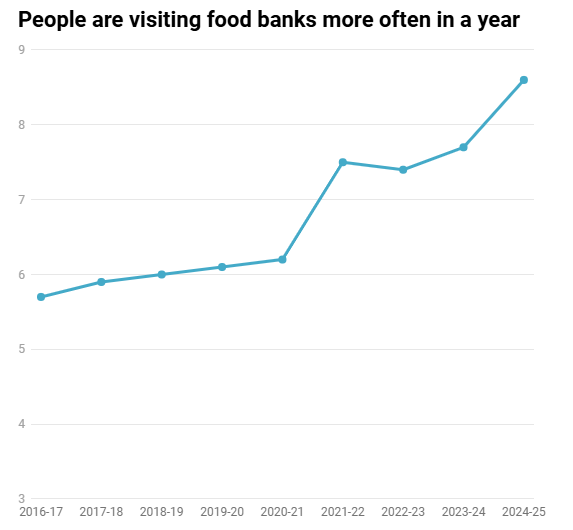
Average food bank visits per unique individual, 2016-17 to 2024-25. Source: Hunger Report 2025.
The risk of growing instability
It may be surprising, but making sure everyone has enough to eat is an important factor for social stability – especially in our rapidly changing world.
Research has shown that food insecurity can play a role in civic unrest and political instability. On an even bigger scale, widespread food insecurity can be an early warning of broader instability, and can even lead to national security risks.
When basic needs are not being met, people start to lose trust in their governments. This loss in trust can lead to social unrest, political instability, or even make people and communities more susceptible to manipulation by external groups that promise a better future.
With more people who need to turn to food banks than ever before, Ontario’s communities are under pressure, but by working together we can begin to create meaningful change.
Together, we can build strong communities
Building strong and stable communities will mean taking action – from a coordinated response at all levels of government to people lending a helping hand to their neighbours. But first, it requires making sure everyone’s basic needs are met, including having a roof over your head, food on the table, and hope for a better tomorrow.
This means ensuring that Ontarians have access to good jobs, affordable housing, healthcare and support, and enough food to eat. When people and families have what they need to thrive, communities thrive too.
To help us be there for those facing hunger in communities across Ontario today, find out how you can support our work, and sign our petition to call for a future where no one needs a food bank in the first place.