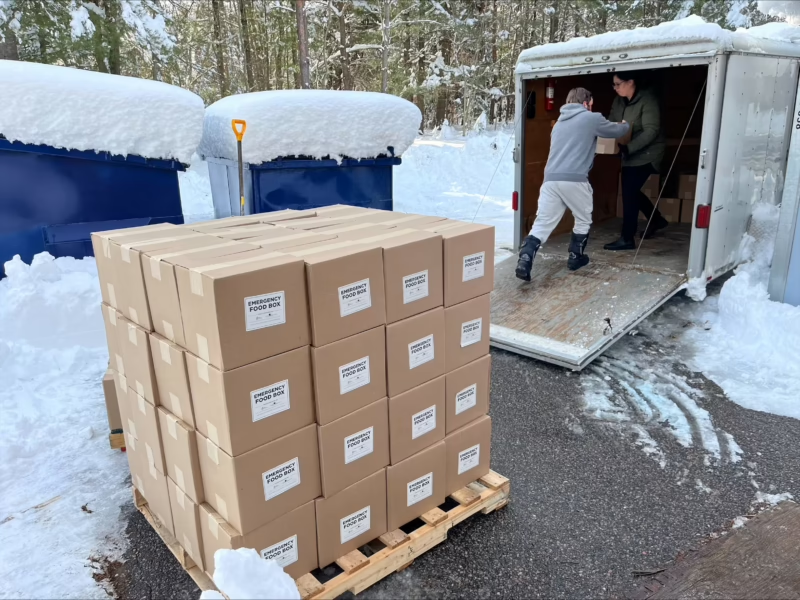
As the provincial network of food banks, we’re creating consistent emergency response systems and equipping food banks across Ontario to support their communities.
To share more about how we provide food to impacted people and families in times of sudden, severe emergencies, we spoke to our Associate Director of Operations and Programs, Adelaide Wimpenny, about how we prepare and take action during emergencies.
How does Feed Ontario make sure the provincial food bank network is ready for emergencies?
Food banks were designed to support individuals in times of personal emergency, like an unexpected job loss. But sometimes when there’s a community-wide emergency, like flooding, power outages, or other natural disasters, scaling the support a food bank provides can be quite challenging.
Feed Ontario has created an online learning platform for food banks, that applies the terminology and decision-making frameworks used in emergency management processes tailored for the food bank setting to give our network the confidence they need when they’re asked to respond during emergencies.
With the support of Ontario Corps and Food Banks Canada, we also help food banks by providing emergency food boxes. These hampers are pre-packed, ready to ship, and stored in key locations across the province so we’re ready for a quicker response and turn around.
Why is Feed Ontario involved in Ontario Corps?
Because of the emergency preparedness strategies we have in place for our network, the province welcomed Feed Ontario as an Ontario Corps partner. Ontario Corps is the province’s network of skilled partners and volunteers that can be called on to help in emergencies.
Feed Ontario has been part of Ontario Corps since 2024 and it was recently announced that we will receive a third year of funding through this initiative. We’re incredibly grateful to be part of Ontario Corps and this funding allows us to continue providing programming through training and response efforts for the provincial food bank network.
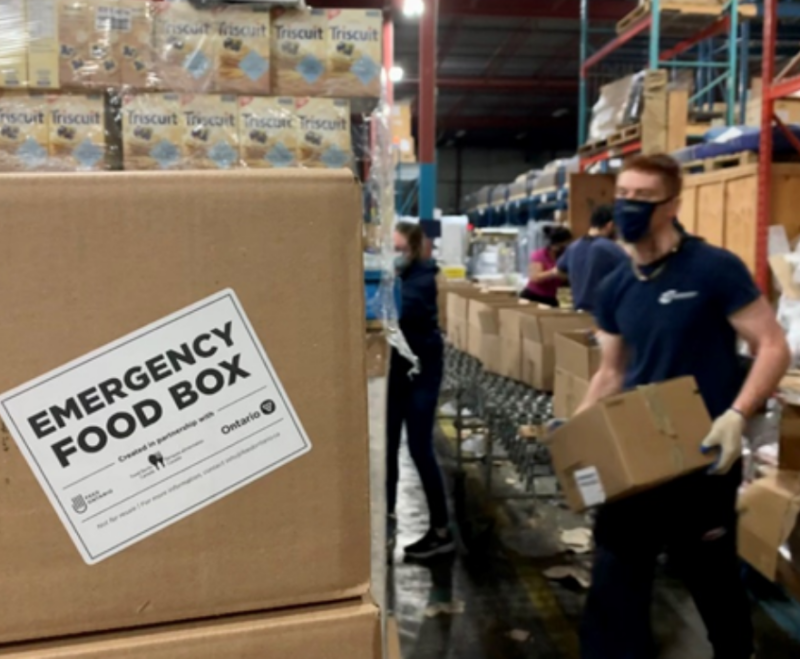
Our partnership with Ontario Corps helps us efficiently provide food and support to communities impacted by emergencies.
What does Feed Ontario’s participation in Ontario Corps mean for the food banks responding to emergencies?
Our Emergency Food Box Program through Ontario Corps has played a significant role in shortening our response time and means we can quickly get food to the people who need it, which is more important than ever in times of emergency. It also means our food bank network knows that support is coming, and they don’t need to organize the response on their own.
Working through Ontario Corps on deployment ensures we have clear communication lines between partner organizations, municipalities, and the province. By having the food boxes packed and stored, as well as eliminating duplicated communication lines and efforts, our response timeline has been shorted by almost 70%. This helps us provide efficient support to impacted communities when it’s most urgent.
What value does Feed Ontario bring to emergency response work?
Our network is made up of more than 1,200 hunger-relief organizations in every corner of Ontario, and this means we have members in both urban and rural areas – with food banks serving anywhere from 30 people to 100,000 people per month. We understand the capacity and scale to which a food bank might be serving its community, an essential aspect of being able to coordinate a response specific to what a particular region might need in an emergency.
What are some emergencies Feed Ontario has responded to in the past?
In the past we’ve responded to events like tornadoes, forest fires, and floods, including the recent flooding in the Muskoka region. We also supported the large response during last year’s April ice storm that caused mass power outages and loss of access to well water for many people.
Sometimes, extended emergencies like these mean people and families need to evacuate their communities and wait elsewhere in the province until it’s safe to return. In those cases, or our response can be after the fact, once people are able to return home after having to leave everything behind.
In other situations, emergencies happen on a smaller scale, locally. For example, we’ve provided support when a senior’s residence had flooding or when a food bank itself has had a large sudden loss of food in their warehouse.

Emergency food boxes recieved in Gravenhurst during the recent flooding in the Muskoka region. Photo by Gravenhurst Against Poverty.
What is Feed Ontario’s main goal in emergency preparedness?
Ultimately our hope for our emergency preparedness programming is that our food banks feel as supported and prepared as possible as we head into an increasingly unpredictable climate, both socially and environmentally.
We’ve heard really good feedback from members who received emergency food boxes telling us they would have had to recruit volunteers, figure out their own inventory, find boxes to put it in, and find someone to distribute it. Alleviating that massive amount of work in a time of emergency is something that we hope to continue to do.
We already know the resources available to food banks are limited, the need for food banks is increasing, and any way that we can create programming that alleviates some of that for them in an acute emergency is a win for us.
–
Learn more about how we’re strengthening food banks, supporting communities, and working to end hunger, or consider supporting our work as we prepare for emergencies and equip food banks so they can be there when they’re needed most.